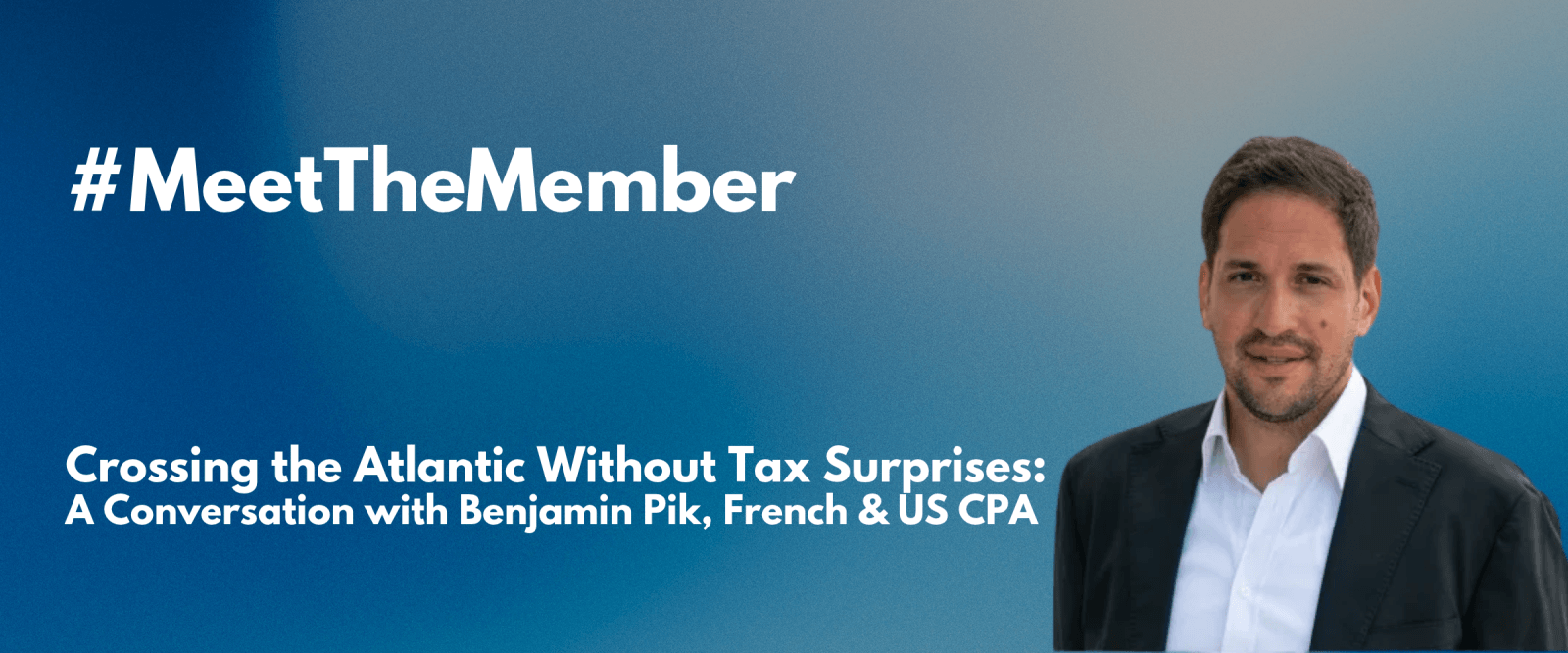
Crossing the Atlantic Without Tax Surprises: A Conversation with Benjamin Pik, French & US CPA
Benjamin, you work on both sides of the Atlantic. How would you describe your practice?
I am a US CPA and a French expert-comptable, and my work sits at the intersection of the two systems. Our clients are French companies setting up in the US, American companies entering France, and families and executives who move between the two countries. They rarely need "French tax" or "US tax"; they need both, coordinated.
What is the most common mistake you see when a French company expands to the US?
Treating the US subsidiary as a simple extension of the French company. A US entity owned by a French parent has its own reporting obligations from day one. Form 5472, for instance, carries a USD 25,000 penalty per missed form. There are also state taxes, sales tax and payroll registrations that vary from one state to another. Intercompany flows, such as management fees, loans and recharged salaries, need to be documented on both sides. When the French and US advisors do not talk to each other, the same income can be taxed twice, or the documentation does not match.
And for individuals?
Residency is the first question, and the two countries do not answer it the same way. The US looks at citizenship, green card status and days of presence. France looks at the home, the main professional activity and the center of economic interests. Someone can be a tax resident of both countries at the same time. The US-France tax treaty then decides, but only if it is applied correctly in both returns.
Which differences surprise people the most?
Three come up constantly. First, US citizens and green card holders are taxed on their worldwide income wherever they live. Second, many French savings products, such as assurance-vie contracts and French investment funds, can be treated as PFICs in the US, with heavy reporting and unfavorable taxation. Third, foreign bank accounts must be reported on the FBAR once combined balances exceed USD 10,000, and penalties can be severe even when no tax is due.
What about employees sent abroad?
Global mobility is where tax, payroll and social security meet. Before an assignment, you need to know where the employee will be taxed, which payroll applies, and whether the French-US social security agreement allows them to stay under the French system. Equity compensation and departure taxes, including the French exit tax, also need to be anticipated, not discovered.
Can you share a situation where planning made the difference?
A French group was about to send an executive to New York with a package designed only from the French side. By reviewing it jointly before departure, we aligned the employment contract, the US payroll and the French and US returns. That avoided double taxation of the bonus and a costly correction a year later.
What advice would you give a FACC-NY member starting a US project?
Bring your French and US advisors together before you sign anything. Structure, contracts and payroll are cheaper to get right at the start than to fix afterwards. Cross-border tax is less about knowing every rule than about making two systems work together.
About the author
Benjamin Pik is a Partner at Expand CPA & Endrix, a cross-border accounting, tax and advisory firm with offices in Miami, Paris and Tel Aviv, specializing in international taxation, global mobility and cross-border business advisory.
He is a U.S. Certified Public Accountant (CPA), a French Chartered Accountant (Expert-Comptable), a French Statutory Auditor (Commissaire aux Comptes), and an IRS Certifying Acceptance Agent (CAA). His dual French and American qualifications enable him to provide integrated tax and accounting advice across both jurisdictions.
Benjamin advises French and American companies, entrepreneurs, executives, investors and internationally mobile families on complex U.S.–France tax matters. His areas of expertise include cross-border tax compliance, international tax planning, corporate structuring, tax residency, and the tax implications of international relocation and investment.
He has extensive experience assisting businesses with their international expansion, particularly French companies establishing operations in the United States and American businesses entering the French market. He also supports individuals and families navigating the complexities of dual tax reporting obligations, international assets and cross-border financial arrangements.
As a Partner at Expand CPA & Endrix, Benjamin plays an active role in developing the firm's international activities and strengthening its presence across Europe, the United States and Israel. He is committed to delivering practical, tailored solutions that combine technical expertise with a strong understanding of the business and personal challenges associated with operating across borders.
Website: www.expand-cpa.com